
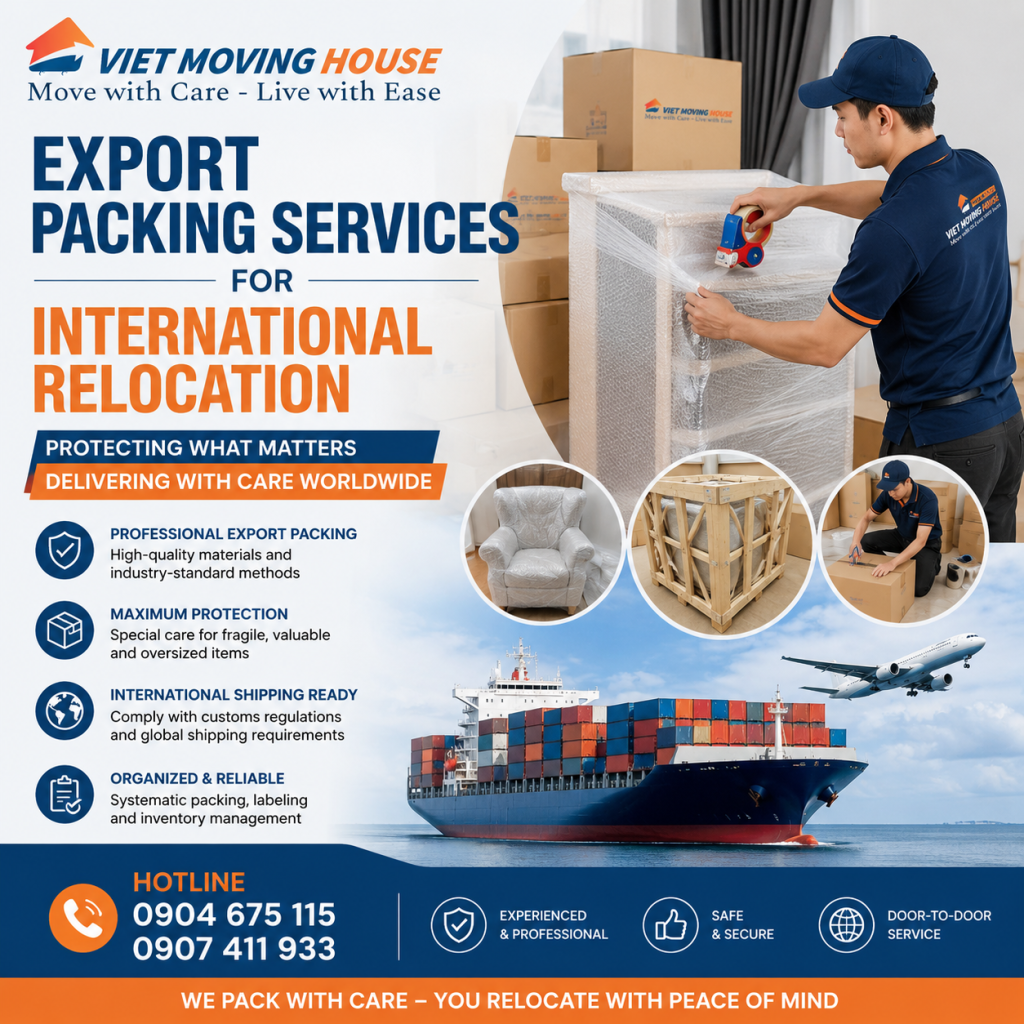
International relocation involves more than simply transporting household goods from one country to another. One of the most important factors in overseas moving is proper export packing. Without suitable packing methods, furniture, personal belongings, appliances, and fragile items can easily be damaged during loading, customs handling, sea freight, or air transportation. Humanity somehow managed to invent intercontinental logistics before figuring out how to stop people from putting ceramic plates loose inside cardboard boxes. A remarkable species.
Professional export packing services for international relocation help ensure that household goods are protected, organized, and prepared for long-distance transportation across multiple stages of transit.
1. What Are Export Packing Services?
Export packing services are specialized solutions used to prepare household goods and personal belongings for international transportation. Unlike domestic moving, overseas relocation involves multiple handling stages such as trucking, warehouse storage, customs inspection, container loading, sea freight, or air freight. Because of this, cargo requires stronger protection and more organized preparation.
These services help reduce risks including:
- Impact during handling
- Vibration during transportation
- Moisture and humidity exposure
- Pressure from stacked cargo
- Dust and contamination
- Damage during customs inspections
Professional export preparation also helps organize cargo by category, room, or item type, making transportation and unpacking easier after arrival. For international relocation, protecting household goods is not simply about placing items into boxes. It is part of the logistics process that helps belongings survive long-distance transportation and repeated operational handling. Humans somehow trust cardboard with their entire lives packed inside it. An astonishing level of optimism for a species terrified of weak Wi-Fi signals.
2. Why Export Packing Is Important For International Relocation
International relocation often involves long transportation routes and multiple cargo transfers before delivery. Household goods may be loaded and unloaded several times between trucks, warehouses, ports, airports, and containers. Without proper protection, furniture, electronics, and fragile items can easily become damaged during transit.
Proper export handling helps:
- Reduce the risk of breakage
- Protect fragile household goods
- Prevent scratches and dents
- Improve cargo stability
- Support customs inspections
- Keep items organized
- Minimize movement inside containers
- Reduce moisture exposure
For sea freight shipments, humidity and container condensation are also major concerns. Furniture, books, fabrics, and electronics may be affected if cargo is not properly wrapped and secured.
Professional organization methods also simplify inventory management and help families unpack more efficiently at the destination. In overseas relocation, cargo preparation directly affects transportation safety, handling efficiency, and the condition of household belongings after arrival. People usually realize this after opening a container and discovering their dining chairs somehow evolved into abstract sculpture during transit.

3. Household Items Commonly Requiring Export Packing
Many household goods require specialized handling before international transportation because different items react differently to pressure, vibration, moisture, and repeated handling.
Common household items include:
- Furniture
- Sofas and dining tables
- Beds and mattresses
- Kitchen appliances
- TVs and electronics
- Glassware and ceramics
- Artwork and decorations
- Personal belongings
- Books and documents
- Musical instruments
Fragile items such as ceramics, mirrors, and glass tables usually require additional cushioning to reduce impact damage. Electronics also need careful stabilization because vibration during transportation may affect sensitive internal components.
Large furniture pieces often require surface protection to reduce scratches, dents, or edge damage during loading and unloading operations. High-value belongings such as artwork or antiques may also need reinforced external protection for long-distance transportation.
Because international relocation involves extended transit periods, household goods must be prepared for both handling risks and environmental conditions throughout the journey. Humans become deeply attached to ordinary objects the moment someone starts carrying them toward a shipping container.
4. Materials Used In Export Packing Services
Professional export relocation services use different protective materials depending on cargo type, transportation method, and handling conditions. The goal is to reduce damage risks throughout international transportation.
Common materials include:
- Carton boxes
- Bubble wrap
- Foam sheets
- Stretch film
- Packing paper
- Corner protectors
- Wooden crates
- Wooden pallets
- Moisture-resistant wrapping
- Strapping belts
Bubble wrap and foam sheets are commonly used for fragile household items because they help absorb impact during movement and handling. Stretch film helps stabilize furniture and palletized cargo while also protecting surfaces from dust and scratches.
Wooden crates provide stronger protection for oversized or high-value items such as artwork, marble tables, antiques, or sensitive equipment. Wooden pallets help organize cargo and improve forklift handling efficiency during loading operations.
For sea freight relocation, moisture-resistant materials are especially important because cargo may remain inside containers for long periods under changing temperatures and humidity levels. International logistics is basically humanity trying to defeat gravity, moisture, vibration, and bad handling decisions using tape and layered plastic.
5. Export Packing Methods For International Moving
Different preparation methods are used depending on the size, fragility, and value of household goods during international relocation.
Fragile Item Protection
Fragile belongings are usually wrapped individually using:
- Bubble wrap
- Foam cushioning
- Double-layer cartons
- Internal protective fillers
These methods help reduce direct impact and prevent items from colliding during transportation.
Furniture Protection
Furniture is commonly protected using:
- Stretch wrapping
- Foam padding
- Corner guards
- Protective blankets
Delicate furniture may also be secured inside wooden crates for additional safety during international transportation.
Electronics Handling
Electronic devices such as TVs, monitors, and computers require stabilization to reduce shock and vibration damage during transit.
Wooden Crating
Wooden crates are often used for oversized, fragile, or expensive items because they provide stronger external protection against pressure and cargo movement.
Palletized Cargo Arrangement
Large-volume household shipments are often arranged on pallets to improve cargo stability, simplify forklift handling, and support organized container loading.
Proper cargo arrangement inside containers is also important because uneven weight distribution may increase the risk of shifting during transportation. Humans will spend weeks planning an international move, then still say things like “the vase should survive if we wrap it in towels.” Ancient civilizations collapsed with less confidence than that.
6. Export Packing For Sea Freight Relocation
Sea freight is one of the most common transportation methods for international relocation because it allows larger shipment volumes.
However, ocean transportation exposes cargo to:
- Humidity
- Container condensation
- Long transit times
- Heavy cargo stacking
- Port handling operations
Because of this, export packing for sea freight often includes:
- Moisture-resistant wrapping
- Reinforced carton packing
- Palletized cargo
- Wooden crate protection
- Container load stabilization
Proper container loading also helps prevent cargo movement during ocean transit.
7. Export Packing For Air Freight Relocation
Air freight relocation is commonly used for urgent shipments or smaller household consignments.
Compared to sea freight, air shipments usually require:
- Lightweight packing materials
- Compact carton dimensions
- Efficient cargo labeling
- Fast handling preparation
Although air cargo transit times are shorter, cargo still passes through multiple loading and unloading stages, making protective packing equally important.
8. The Export Packing Process
Professional export packing services generally follow a structured process to ensure cargo safety and organization.
Typical steps include:
- Cargo inspection
- Item classification
- Material preparation
- Protective wrapping
- Carton packing
- Labeling and inventory marking
- Wooden crating if required
- Palletizing cargo
- Final loading preparation
Proper labeling also helps simplify customs clearance and destination delivery procedures.
9. Benefits Of Professional Export Packing Services
Using professional export packing services for international relocation offers several advantages:
- Better cargo protection
- Reduced handling damage
- Improved cargo organization
- Faster loading operations
- Easier inventory management
- More efficient unpacking at destination
- Safer international transportation process
Professional packing teams also understand how to arrange cargo efficiently inside containers or air freight shipments to maximize space utilization.
10. Choosing The Right Export Packing Service Provider
When selecting an export packing company for international relocation, important factors include:
- Experience with overseas relocation
- Knowledge of international shipping requirements
- Proper packing materials
- Skilled packing crews
- Ability to handle fragile cargo
- Organized inventory management
- Understanding of container loading techniques
A reliable export packing process helps minimize risks throughout the international moving journey.

Conclusion
Export packing services play a critical role in international relocation by helping protect household goods throughout long-distance transportation and multiple handling stages. From furniture and electronics to fragile personal belongings, proper export packing helps improve cargo safety, organization, and overall relocation efficiency.
International moving is already complicated enough without discovering your coffee mugs arrived overseas as powdered ceramic archaeology samples. Proper export packing exists because gravity, humidity, forklifts, and human overconfidence continue to work together with terrifying efficiency.
